The Land of the Pharaohs by Leonard Cottrell
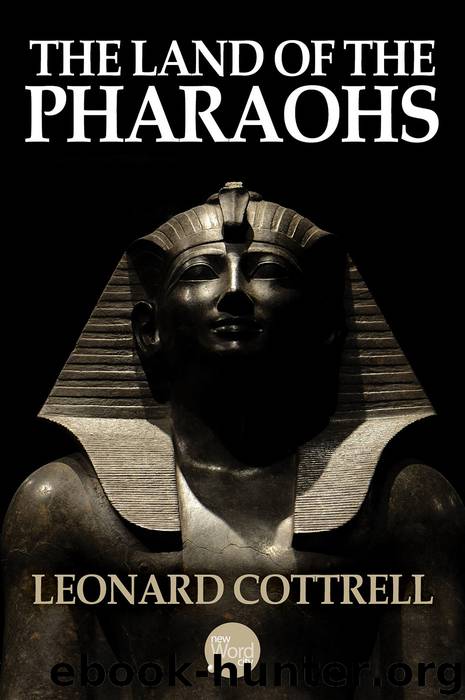
Author:Leonard Cottrell [Leonard Cottrell]
Language: eng
Format: epub
Tags: History/Ancient/Egypt
ISBN: 9781936529834
Publisher: New Word City, Inc.
Published: 2016-12-30T05:00:00+00:00
As the royal ship glided toward its next anchorage, Ankhesnamen was thinking about her past and her future. Six years ago, she had been a ten-year-old child running around the women’s quarters in the Palace of Ikhnaton. She had had many playmates, because in an Egyptian royal household, a child was brought up not only among her own blood brothers and sisters but among her numerous half-sisters, cousins, and other relatives. They played games; the small girls had dolls and the boys mechanical toys, including an animal on wheels which nodded its head when you pulled it along; when they were older they played with gaming boards (like modern chess or checkers), and the boys practiced archery with small bows and arrows.
But all the time they were conscious that they were royal children, different from the children of the slaves and servants who attended them, and the peasants whom they saw working in the fields when the king took them for a ride in his chariot. Ankhesnamen had loved those rides. Since she was Ikhnaton’s daughter, her name, at first, had been Ankhespaten; the name of her father’s god - the Aten - had been incorporated into her own. It was only later that the priests of Amen had made her change it to Ankhesnamen.
She also remembered her mother, the beautiful queen Nefertiti, Ikhnaton’s chief wife. Nefertiti’s name in ancient Egyptian means “the beautiful woman has come,” and Ankhesnamen had inherited much of her mother’s beauty. Sometimes the king would take Nefertiti and several of their daughters for a chariot ride through the city which he had founded. The people, thousands of them, would come out onto the streets to cheer them. The pharaoh and his wife laughed and smiled, and the children (all girls, for Ikhnaton had had no son) shrieked and giggled as they clung to the chariot rails, and Ankhesnamen’s sister Beketaten, always the mischievous one, would try to poke the rumps of the galloping horses with a stick. It was all great fun, and highly unconventional, because in the sculptures of the old kings (which Ankhesnamen had seen), the king was never shown like that - enjoying a drive with his children - but always looking solemn and majestic, like a god. It had never occurred to her that this was wrong until the priests of Amen told her so. How shocked they were, those dull, dreary old men, when they saw a statue of Ikhnaton actually dandling one of his children on his knee. And on another, the sculptor had shown the chariot ride, with Beketaten trying to poke the horses with her stick!
The priests, she knew, had ordered nearly all these portraits of her father destroyed. She hoped that they hadn’t found all of them, though they had even broken into the tombs to obliterate the memory of the hated Heretic. (Fortunately, the picture described here can still be seen in the tombs of Tell el-Amarna.) Why had they wanted to destroy them? Because,
Download
This site does not store any files on its server. We only index and link to content provided by other sites. Please contact the content providers to delete copyright contents if any and email us, we'll remove relevant links or contents immediately.
| Africa | Americas |
| Arctic & Antarctica | Asia |
| Australia & Oceania | Europe |
| Middle East | Russia |
| United States | World |
| Ancient Civilizations | Military |
| Historical Study & Educational Resources |
The Daily Stoic by Holiday Ryan & Hanselman Stephen(3364)
The Fate of Rome: Climate, Disease, and the End of an Empire (The Princeton History of the Ancient World) by Kyle Harper(3090)
People of the Earth: An Introduction to World Prehistory by Dr. Brian Fagan & Nadia Durrani(2759)
Babylon's Ark by Lawrence Anthony(2721)
Ancient Worlds by Michael Scott(2719)
The Daily Stoic by Ryan Holiday & Stephen Hanselman(2709)
India's Ancient Past by R.S. Sharma(2493)
Foreign Devils on the Silk Road: The Search for the Lost Treasures of Central Asia by Peter Hopkirk(2482)
MOSES THE EGYPTIAN by Jan Assmann(2449)
The Complete Dead Sea Scrolls in English (7th Edition) (Penguin Classics) by Geza Vermes(2312)
The Earth Chronicles Handbook by Zecharia Sitchin(2256)
Lost Technologies of Ancient Egypt by Christopher Dunn(2255)
24 Hours in Ancient Rome by Philip Matyszak(2101)
Alexander the Great by Philip Freeman(2087)
Aztec by Gary Jennings(2057)
The Nine Waves of Creation by Carl Johan Calleman(1937)
Curse Tablets and Binding Spells from the Ancient World by Gager John G.;(1884)
Before Atlantis by Frank Joseph(1878)
Earthmare: The Lost Book of Wars by Cergat(1843)
